

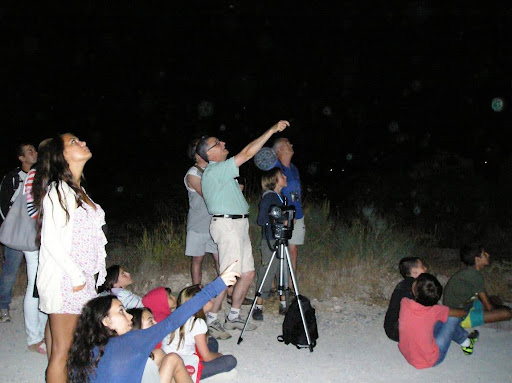
When we think of Alicante, our minds naturally turn to the Mediterranean, the coves, the seaside promenades, and the outdoor cafes. But you only have to drive inland for the landscape to change completely. Mountain ranges, valleys, small villages, and rural areas gradually replace the lights of the coast. And when night falls, another option emerges that deserves far more attention than it usually gets: find a quiet place to look at the stars.
Here at Bacacay, we love the side of Alicante that doesn't always make it onto postcards. That's why we've put together this guide with Seven Mountain Areas in Alicante Where You Can Enjoy the Night Sky, from the Maigmó area to Aitana, passing through Mariola and the Sierra de Salinas. We’re not going to promise you perfect skies every night or tell you to climb a peak in the dark. The quality of the viewing depends on the clouds, the Moon, nearby light sources, and the specific conditions at each location. The idea is much more practical: to give you places where it’s worth starting your search and to explain how to plan wisely.
What makes a good spot for stargazing in Alicante?
Before deciding where to go, there's one thing we should clarify: Being higher up doesn't automatically mean you can see the stars better. A spectacular peak may be difficult to reach, exposed to the wind, or unsuitable for spending the night. For a peaceful stargazing experience, it’s much better to find a permitted spot that’s relatively unobstructed and away from the brightest light sources.
Light pollution is one of the major factors. The closer you are to the glow of cities and large urban centers, the harder it is to make out the dimmer stars. That’s why the interior of the province has an advantage over the more urbanized coastal areas. Turisme Comunitat Valenciana specifically highlights sparsely populated areas such as the Mariola Mountain Range or the area around the Vall de Gallinera among the destinations in Alicante that are of interest for astrotourism due to their skies with less light pollution. (Valencian Community)
The horizon matters, too. If you find an open area where the sky isn’t completely blocked by trees, buildings, or mountain walls, you’ll be able to take in a larger portion of the night sky. You don’t need to find a scene straight out of a science fiction movie. You need darkness, some open space, and, above all, a clear night.
1. El Maigmó and the Balcón de Alicante: a great first taste
The Maigmó It is one of the natural highlights of inland Alicante and one of the first areas worth considering if you want to go out at night without venturing to the far reaches of the province. The Regional Government of Valencia lists Maigmó, at 1,296 meters, and the Balcón de Alicante recreational area among the points of interest in the Sierras del Maigmó y del Cid Protected Landscape. (Natural Parks)
The point of this article isn't to recommend that you reach the summit after dark. The plan can be much simpler. The Balcón de Alicante and the accessible spaces in its vicinity They allow you to enjoy the mountain scenery without turning stargazing into a strenuous nighttime hike.
Furthermore, we aren’t choosing Maigmó just because “mountain + stars” sounds good. The area has a genuine history of astronomical observation. The AstroElda group has held stargazing nights there, during which participants have identified constellations and observed the sky through a telescope.
If this is your first outing of this kind, I’d suggest keeping the plan fairly simple: arrive before it gets completely dark, get familiar with the surroundings while there’s still light, and then stay at a designated, comfortable spot. Watching the last light of day gradually fade away is part of the experience.
2. Xorret de Catí: a staple of Alicante’s astronomy nights
Very close to the Maigmó universe, we find Xorret de Catí, between Castalla and Petrer. And here, the astronomical references are even clearer. Alicante Natura has organized several “Night of the Stars” events at this site, and in 2024, AstroElda held a stargazing event there with telescopes, attended by numerous families and members of Astroingeo. (Alicantenatura)
That makes Xorret de Catí a particularly interesting choice for this guide: we’re not just talking about a place with beautiful scenery, but also about a space actually used for astronomy outreach activities.
There is, however, one important detail to keep in mind if you are currently planning a visit. Throughout 2026, the Alicante Provincial Council is carrying out renovation and refurbishment work on the former hotel in Xorret de Catí to transform it into a center dedicated to active tourism and ecotourism. Work has also been done on parking lots, trails, and signage in the surrounding area. (Alicante Provincial Council)
That's why, before heading out at night, it's a good idea to check the current status of access points and construction zones. A useful guide shouldn't send you there based on a photo from five years ago and expect everything to be exactly the same.
As an experience, Xorret de Catí is especially great if you're looking for mountains, forests, and that unique feeling of being just a short distance from urban areas while still being surrounded by nature.
3. Sierra de Salinas: when you really want to get away from the city lights
If you're looking for an experience that focuses more on the sky than on visiting a well-known lookout point, the Sierra de Salinas and the Monóvar Hinterland deserve special attention. Here we have a fairly direct reference: Astroturismo Alicante conducts its regular observations south of the Sierra de Salinas, in the hamlet of Cañadas de Don Ciro, within the municipality of Monóvar. (Astro-Tourism in Alicante)
The organization itself describes this part of the interior as a rural area far from large urban centers and uses this location specifically for its stargazing events. In its information on activities, it lists the usual observation point as being at an elevation of about 670 meters and describes it as a refuge from the most intense light pollution in the southeast. (Astro-Tourism in Alicante)
That tells us something interesting: to stargaze, you don't always need a famous mountain that's featured in every guidebook. Sometimes a rural setting at the foot of a mountain range—far enough away from big cities—is more appealing.
If you don't have experience identifying constellations, planets, or deep-sky objects, this is also one of the areas where it makes sense to consider a activity led by astronomy educators instead of just arriving, looking up, and spending half an hour wondering which of all those dots was supposedly Saturn.
4. Sierra de Mariola: Nature and Skies in the Interior of Alicante
The Mariola Mountain Range It is one of the great mountainous landscapes in the north of the province of Alicante and extends into Valencia as well. The natural park covers a large area spanning regions such as l’Alcoià, El Comtat, and la Vall d’Albaida, and features numerous peaks over 1,000 meters. Montcabrer reaches 1,390 meters. (costablanca.org)
But, again, altitude isn't the main reason it appears here. Turisme Comunitat Valenciana specifically mentions the Sierra de Mariola as one of the areas in Alicante with skies that have low light pollution and are suitable for stargazing. (Valencian Community)
That opens up quite a few possibilities for a getaway. You can spend the afternoon exploring one of the nearby towns and set aside the last few hours of the day to find a designated, unobstructed spot from which to observe the sky.
What we wouldn't recommend is turning the experience into a nighttime climb up Montcabrer simply because it's the highest point in the mountain range. If you're going stargazing, safety, comfort, and the ability to stay still for a long time are much more important than being able to boast about having gained a few hundred meters in elevation.
Mariola also has that advantage we love so much about the mountains of Alicante: it lets you plan a complete getaway. You don’t have to drive all the way there just to spend forty minutes gazing at the sky. You can explore villages and trails during the day and save the evening for a complete change of perspective.
5. Font Roja: Gaze at the sky amid the landscape of Alcoy and Ibi
The Carrascal de la Font Roja Natural Park, located between Alcoy and Ibi, is another of the great natural areas in the mountains of Alicante. (Natural Parks) Its combination of forests and highlands makes it a completely different setting from what many people imagine when they first think of Alicante.
In addition, Font Roja also has a history of promoting astronomy. AstroAlcoy has participated in public observation events in the park, including activities in the Pla de la Mina area. (astroalcoy.org) This doesn't mean that any part of the park is open for visitors to set up camp at any time, but it does show that the area has been used to observe and explain the night sky.
As of the date of this inquiry, official information from the Natural Park indicates that General access to the Font Roja area is unrestricted, and there are no checkpoints regulating vehicle access.. Since these conditions may change due to venue management, construction, or unforeseen circumstances, it's a good idea to check the official website before planning a night out. (Natural Parks)
One rule applies here in particular: don't improvise. If you want to spend some time stargazing, choose a permitted, easily accessible area in advance. It's not worth venturing down an unfamiliar trail at night just to get another 500 meters away from a streetlight.
6. Vall de Seta and Serrella: Rural Alicante, Where You Can Slow Down
For those looking for a lesser-known landscape, the Vall de Seta and the area around La Serrella They offer a very rural view of the province. Quatretondeta, for example, is located in El Comtat and is surrounded by a mountainous landscape dominated by the Serrella and the distinctive rock formations known as Els Frares. (Valencian Community)
Here, the appeal lies more in the overall setting than in any specific astronomical observation point. Small towns, rural roads, mountainous terrain, and a much lower population density than along the coast create the kind of environment where it makes sense to seek out dark, authorized observation sites.
Recent guides specifically dedicated to stargazing in Alicante place the Vall de Seta among the recommended areas, along with Xorret de Catí and Sierra de Salinas. (LinkAlicante) We would consider this a guideline for exploring the area, not a guarantee that every shoulder or road is suitable for stopping.
And that’s important. A night under the stars isn’t about parking where “it seems like you won’t be in the way.” Look for designated public areas, respect private property, and avoid blocking farm or forest roads. The rural landscape is beautiful precisely because there are people who live and work there year-round.
7. The Aitana and Guadalest Valley Area: Majestic Mountains Without the Need to Conquer the Summit
We'll wrap up with one of the most striking images of Alicante's city center: the Aitana Mountains and the Guadalest Valley. Aitana rises to 1,558 meters and is the highest peak in the province. The surrounding landscape connects towns such as Confrides, Benifato, Benimantell, and Castell de Guadalest, with the Serrella and other mountain ranges creating a particularly striking mountainous setting. (costablanca.org)
It’s easy to fall into the trap of thinking, “If Aitana is the highest mountain, the summit must be the best place to stargaze.” We wouldn’t approach it that way. The upper area has facilities and access points that aren’t open to the public, and besides, a high summit isn’t necessarily the most comfortable place to spend hours gazing at the sky.
The interesting part is in the area around Aitana, its valleys, and the accessible areas of the nearby towns. You can explore the area during the day, wait for dusk to fall, and then find a designated spot from which to enjoy the changing light over the mountains.
There is even historical documentation of amateur astronomers conducting observations on Aitana, although some of those expeditions involved specific access to areas that should not be used as a reference for a private visit. The practical lesson is exactly the opposite: enjoy the scenery without assuming you need to reach the highest point.
What's the best mountain in Alicante for stargazing?
There's no single answer. If you're looking for a place with a long tradition of astronomy-related activities, Xorret de Catí and the Maigmó Area These are two very interesting options. If your priority is to get away from the lights of the most densely populated areas, the rural setting of Sierra de Salinas has a particularly strong case because astronomical observations are routinely conducted there. (Astro El Da)
If you want to turn this experience into a full-fledged mountain getaway, Mariola, Vall de Seta, or the area around Aitana They also offer plenty to do during the day. In these cases, nighttime stargazing works best as the final part of a day spent exploring the countryside rather than as a standalone activity.
Your choice should also depend on where you're staying. Driving a long way at night just because someone online has proclaimed a place to be “the best” doesn't make much sense if there's another suitable spot much closer by.
How to Choose a Good Night for Stargazing
The site is only half the plan. The other half is right above your head.
The first thing you should check is the weather forecast. If it's very cloudy, not even the darkest mountain range in the province will work its magic. It's also worth checking the wind and temperatures, because conditions at higher elevations can be quite different from those in the city of Alicante.
Then there's the Moon. A night with bright moonlight can make it difficult to observe fainter objects. The National Geographic Institute publishes an annual astronomical calendar featuring lunar phases, eclipses, and other phenomena, so it’s a good resource for choosing a date before planning your trip. (Astronomy)
This is especially noticeable during meteor showers. The IGN itself recommends looking for the darkest areas of the sky and taking the Moon's position into account during observation. (Astronomy)
There’s also no need to obsess over creating professional observatory conditions. If your goal is to spend a unique evening, identify a few constellations, and enjoy a sky much more filled with stars than what you usually see from the city, a clear night and a dark setting can already provide you with a memorable experience.
How to Enjoy the Night Sky Without Complicating Your Evening
The best plan is the one that ends just as well as it begins. That's why, if you're heading to a mountainous area at night, Don't improvise routes or climbs. Arrive while it's still light out whenever possible, use permitted and familiar areas, and don't venture onto trails you don't know once it gets dark.
It’s also not a good idea to go alone to remote areas at night. Plan your outing with a companion and make it clear in advance where you’ll be going and how you’ll get back. In the mountains, temperatures can drop significantly once the sun goes down, so it’s a good idea to check the conditions before heading out and dress appropriately for the location and time of year.
Once installed, use only as much lighting as necessary. A bright light shining continuously into the surrounding area will force your eyes to readjust to the darkness and may disturb others who are observing the sky.
And, of course, everything you bring with you should come back with you. You’re entering natural and rural areas, some of which are protected. The best souvenir you can leave behind is none at all.
Do you need a telescope to see stars in Alicante?
No. And that's probably one of the best pieces of news to start with.
With the naked eye, you can enjoy the constellations, identify bright stars, and watch meteor showers when conditions are right. A telescope lets you get a closer look at other objects, but it's not necessary to enjoy the night sky.
In fact, on your first outing, it might be more fun to learn how to find your bearings and gradually figure out what you’re seeing. If you later get hooked on astronomy—which is quite easy to do—you can always join an organized activity where someone with experience will explain what you’re looking at and how the equipment works.
Alicante is home to groups and projects that organize these kinds of experiences, ranging from astronomy gatherings in the countryside to guided sessions at other locations throughout the province. (Astro El Da)
Frequently Asked Questions About Where to See Stars in Alicante
Where is the best place in Alicante to stargaze?
It depends on the conditions that night and how far you’re willing to travel. Xorret de Catí is known for having repeatedly hosted astronomical events, while the area south of the Sierra de Salinas is currently used by a project specializing in astro-tourism. Mariola is also highlighted by Turisme Comunitat Valenciana as one of the sparsely populated areas in Alicante with skies ideal for stargazing. (Astro El Da)
Can you see the Milky Way from the mountains of Alicante?
Under sufficiently dark conditions and with the right sky, parts of the Milky Way can be seen, but this isn't something we can guarantee for every location or every night. Light pollution, the Moon, the time of year, atmospheric clarity, and the specific observation location all play a huge role. The best strategy is to seek out dark skies and choose the date carefully.
When is the best time to go stargazing?
Look for a night with few clouds and check the Moon’s phase and position. If you also want to observe a specific phenomenon, such as a meteor shower, check the official dates in advance. The National Geographic Institute maintains an annual astronomical calendar that includes exactly this information. (Astronomy)
Where can you see the Perseids in Alicante?
Xorret de Catí is one of the places where special events have been organized to observe the Perseids, including one hosted by AstroElda in 2024. (Cadena SER) That doesn't mean it's the only possible location: any authorized area with low light levels and a reasonably unobstructed horizon can work if the astronomical and weather conditions are right.
Which is better: a mountain or a lookout point near Alicante?
For casual stargazing, an accessible and relatively dark spot is usually a better choice than a difficult-to-reach mountaintop. Comfort matters because stargazing means spending quite a bit of time sitting still. You don't need to conquer any mountains to enjoy the stars.
Can I go to any of these places at night?
You shouldn't take it for granted. Natural areas may have rules, seasonal restrictions, construction projects, or changes to access points. Always check the official information for the location before you go and respect any restrictions in place. This is especially important in natural parks and during periods of high fire risk.
Another way to discover Alicante begins when night falls
Alicante is fortunate in that it allows you to go from the Mediterranean to mountainous landscapes within a relatively small area. And once you leave the more bustling areas behind, a whole new side of the province emerges: Maigmó, Xorret de Catí, Sierra de Salinas, Mariola, Font Roja, Serrella, and Aitana completely transform the kind of getaway you’re having.
You don't need to know anything about astronomy or bring a huge telescope. Sometimes all it takes is choosing the right night, finding a quiet spot, waiting a few minutes, and looking up. With so many plans that involve arriving, taking a photo, and rushing off to the next place, there's something truly special about simply gazing at the sky.
And if your mountain hike begins or ends in the city of Alicante, you can also set aside some time for a different kind of experience. Reserve a table at Bacacay …and wrap up your getaway by sharing a delicious meal right in the heart of Alicante.
 English
 Spanish